State police won’t affect Amotekun operations – DAWN DG
 admin
admin

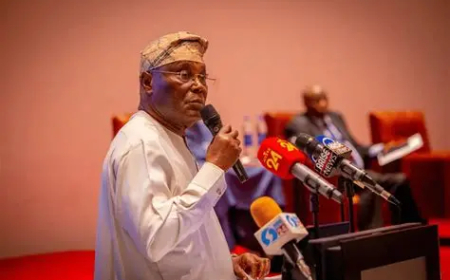
The Director-General of the Development Agenda for Western Nigeria, Seye Oyeleye, has said the establishment of state police will not affect the operations of the Western Nigeria Security Network, codenamed Amotekun, in the South-West states.
He said Amotekun and state police could coexist within the region’s security architecture.
Oyeleye stated this during a roundtable session titled ‘Foundational Imperatives for State Police in South-West Nigeria,’ held at the Dipo Famakinwa Conference Room, DAWN Commission headquarters, Cocoa House, Dugbe, Ibadan, Oyo State capital, on Thursday.
According to him, the session was convened in response to the growing momentum at the federal level for the establishment of state police.
The Director-General of the Development Agenda for Western Nigeria, Seye Oyeleye, has said the establishment of state police will not affect the operations of the Western Nigeria Security Network, codenamed Amotekun, in the South-West states.
He said Amotekun and state police could coexist within the region’s security architecture.
Oyeleye stated this during a roundtable session titled ‘Foundational Imperatives for State Police in South-West Nigeria,’ held at the Dipo Famakinwa Conference Room, DAWN Commission headquarters, Cocoa House, Dugbe, Ibadan, Oyo State capital, on Thursday.
According to him, the session was convened in response to the growing momentum at the federal level for the establishment of state police.
The Director-General of the Development Agenda for Western Nigeria, Seye Oyeleye, has said the establishment of state police will not affect the operations of the Western Nigeria Security Network, codenamed Amotekun, in the South-West states.
He said Amotekun and state police could coexist within the region’s security architecture.
Oyeleye stated this during a roundtable session titled ‘Foundational Imperatives for State Police in South-West Nigeria,’ held at the Dipo Famakinwa Conference Room, DAWN Commission headquarters, Cocoa House, Dugbe, Ibadan, Oyo State capital, on Thursday.
According to him, the session was convened in response to the growing momentum at the federal level for the establishment of state police.
There will be a common template, but there are individual peculiarities. That is why we are a federation. The mistake we do not want to make again is the ‘one size fits all’ approach.
“If you have a population of over 200 million people and about 450,000 active policemen, how effective can that be? What we are trying to do is develop a guiding template for the six states.”
He added that the outcome of the meeting would be presented to South-West governors as a basis for policy direction, expressing confidence that state policing could become operational by early 2027.
“We believe that by the first quarter of 2027, state police will become a reality. That is why we are doing this now,” he said.
In his contribution, a Professor of African History, Peace and Conflict Studies at the Institute for Peace and Strategic Studies, University of Ibadan, Prof Olawale Albert, stressed that the focus should be on how to implement state policing effectively rather than debating its necessity.
He warned against replicating the shortcomings of the federal policing system, urging stakeholders to adopt a research-driven and analytical approach.
“We cannot jump into state policing without interrogating what is wrong with the federal police. If we do not adopt a rigorous intellectual approach, we may end up with state police behaving like the federal police we criticise today.
“Many communities have already established their own policing structures. Amotekun is one of them. We must draw lessons from these systems to build a police structure that is trusted by the people,” he said.
Also speaking, the Executive Director of Journalists for Democratic Rights, Adewale Adeoye, emphasised that state policing must be people-centred and reflective of local realities.
State policing is not just about the government; it is also about the people. Security must be owned by the people. They must be involved in the conception, the process, and the implementation.
“The nature of crime in the South-West is not the same as in the North-East. State policing here has to reflect our own conditions. We want a structure that commands public integrity, transparency, and meets global standards,” he said.
Culled from punch