Nigerian refugee returnees rise by 1,800
 admin
admin

The number of Nigerian refugees who voluntarily returned home under a tripartite repatriation agreement more than doubled in the first quarter of 2026, rising by 1,805 persons from 1,705 in February to 3,510 by April.
This is as Internally Displaced Persons across the country surged by 166,795 in the same period.
The data is drawn from three successive Forcibly Displaced Populations dashboards published by the United Nations High Commissioner for Refugees for February, March and April 2026, obtained by Sunday PUNCH.
The data was published on May 1, 2026.
The dashboards are produced jointly by UNHCR, the International Organisation for Migration’s Displacement Tracking Matrix, the Nigeria Immigration Service and the National Commission for Refugees, Migrants and Internally Displaced Persons, drawing on biometric registration, field assessments and population profiling across Nigeria’s displacement-affected states.
All returnees documented are Nigerian refugees returning from Cameroon, Chad and Niger Republic under a tripartite voluntary repatriation agreement, and all are returning to their areas of origin in Borno State, epicentre of the Boko Haram and ISWAP insurgency that has driven displacement across the Lake Chad Basin for more than a decade.
The returnee count which stood at 1,705 in February, jumped to 3,083 in March, increasing by 1,378.
It rose further to 3,510 in April, adding another 427. The total Q1 increase of 1,805 returnees shows a 106 per cent rise from February.
The number of Nigerian refugees still registered in Cameroon, Chad and Niger stood at 406,672 in February and declined slightly to 405,062 by March and April, a reduction of 1,610.
Based on the April dashboard, Cameroon alone hosts 124,382 Nigerian refugees, followed by Niger with 258,777 and Chad with 21,999.
Domestically, total IDPs rose from 3,544,519 in February to 3,711,314 in March, an increase of 166,795 in just one month.
The sharpest increase came from the North West, where the IDP count leapt from 650,345 in February to 793,534 in March, a rise of 143,189.
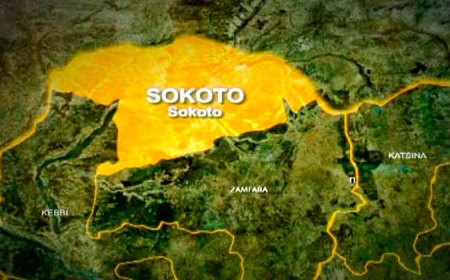
According to the report, the rise is driven overwhelmingly by the relentless banditry campaign across Zamfara, Katsina and Sokoto states.
IOM displacement data noted multiple armed bandit attacks in Zamfara and Katsina between February and April 2026, including a February 2 attack in Anka local government area and a March 12 attack in Bukkuyum LGA that displaced 622 persons from 110 households
The North East held 2,333,190 IDPs as of March and April, up from 2,292,477 in February, a rise of 40,713. The report attributed 92 per cent of the displacement to insurgency and six per cent to communal clashes.
Security incidents in the BAY states of Borno, Adamawa and Yobe increased by 27 per cent between January and March 2026 compared to the same period in 2025, with violence killing or injuring approximately 700 people and displacing over 12,000 since January.
The North Central region recorded 584,590 IDPs in both March and April, down slightly from 601,697 in February.
A state-by-state review of the April 2026 dashboard revealed that Borno hosts 11,318 IDPs and remains the only state receiving returnees under the tripartite agreement.
Adamawa hosts 219,016 IDPs alongside 44,722 refugees, making it the state with the heaviest combined displacement burden outside Borno while Yobe has 162,648 IDPs and 2,200 refugees.
In the North Central, Benue hosts 464,543 IDPs and 8,825 refugees. Taraba has 49,833 IDPs and 15,561 refugees while Plateau hosts 45,212 IDPs.
In the North West, IDP figures in Zamfara state sit at 279,224, the single largest IDP population outside Borno. Sokoto hosts 181,526 IDPs while Katsina hosts 206,071.
In the South South, Cross River hosts 46,846 refugees, almost entirely from Cameroon.
Meanwhile, the total refugee and asylum-seeker population hosted by Nigeria dropped slightly from 142,268 in February to 138,886 in March and rose to 139,141 in April, a reduction of 3,127 persons.
The backlog of refugees awaiting formal registration fell from 16,582 in February to 13,059 in March and 13,055 in April.
Nigerians currently constitute 3.5 per cent of the world’s 117 million forcibly displaced persons, including both those displaced internally and those registered as Nigerian refugees in neighbouring countries, according to UNHCR’s situation overview.
In August 2025, the World Bank approved $300m in financing for the Solutions for the Internally Displaced and Host Communities Project.
The Country Director for Nigeria, Mathew Verghis, stated that the project is expected to benefit up to 7.4 million people, of whom 1.3 million are identified as IDPs, using a coordinated, community-driven approach through all tiers of government.