Kwara rolls out cattle insemination scheme to boost dairy, meat production
 admin
admin
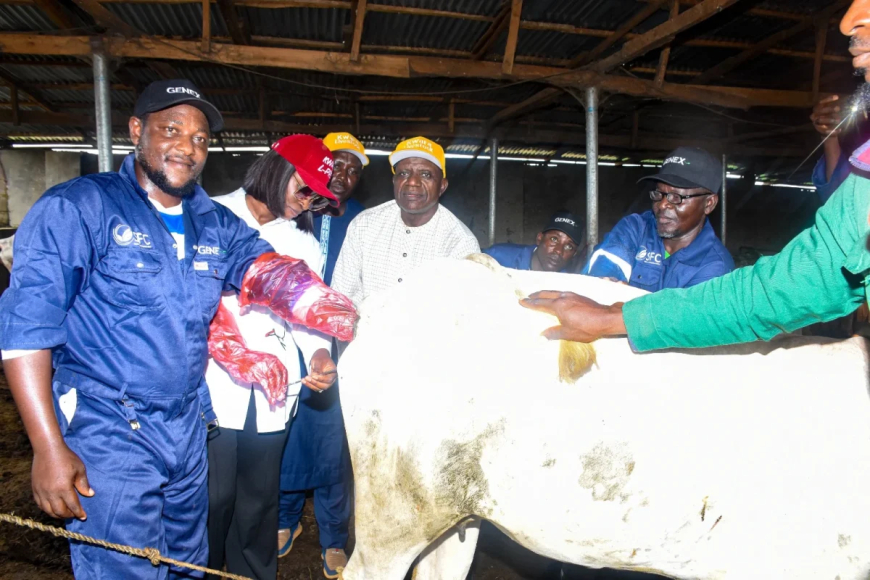
The Kwara State Government has commenced a statewide cattle artificial insemination programme, targeting thousands of animals as part of efforts to improve breeds and increase milk and dairy production.
The initiative, being implemented in collaboration with Genex URUS American International Animal Company, began with 500 cattle in September, while the government hopes to increase the number to about 1,000 by the end of the year.
The Commissioner for Livestock Development, Oloruntoyosi Thomas, disclosed this on Sunday during the flag-off of the exercise at TGB Farms in Ganiki, Ilorin South Local Government Area of the state.
Thomas said the intervention was part of the government’s broader efforts to transform livestock production in the state, adding that artificial insemination would help farmers gain access to improved breeds.
She explained that the animals had first undergone synchronisation as part of preparations for the insemination, adding that the programme would continue beyond the initial phase.
“One of the ways to improve breeds is through artificial insemination. We are going to inseminate thousands of cattle across the state,” she said.
In terms of numbers, we are going to inseminate thousands. We are starting with 500 this month of September, but by the end of the year, we are hoping to reach maybe a thousand, and then we keep going. It’s a long process, but we are just starting.”
Thomas also disclosed plans to establish an artificial insemination centre in the Malete area of the state, with similar facilities expected to be introduced in other identified communities to improve farmers’ access to the service.
She said the state was also developing local capacity by involving students of Animal Production and youths from pastoralist communities in the exercise.
“We need to ensure that we have our well-trained technicians—artificial insemination technicians—and that’s why we are involving our students from the University of Ilorin, the various tertiary institutions in the state,” she said.
According to her, building a pool of trained personnel would help reduce the cost of the exercise, improve the synchronisation process and increase the chances of successful insemination.
The Director of Livestock, Ministry of Livestock Development, Ahmed Umar, said the success of the programme would depend on the cooperation of stakeholders across the livestock sector.
Umar expressed optimism that the exercise would record an 85 per cent success rate, while calling for the support of farmers and other stakeholders.
“We want to develop this sector the way it should be developed by having improved breeds. This cannot be done alone. All stakeholders must come together to ensure success,” he said.
Also, Team Lead of Genex URUS American International Animal Breeding Company, Saka Shittu, said the intervention was designed to improve the quality of cattle through the use of selected semen, particularly to raise dairy production.
“For now, the programme focuses on cattle; it will later be extended to other livestock. The essence of the programme is that animals are being inseminated with improved semen selected to boost dairy production,” Shittu said.
He urged cattle owners, including pastoralists and smallholder dairy ranchers, to participate in the scheme, stressing that the service was currently being provided free of charge in Kwara.
Shittu added that each farmer was entitled to have two cattle inseminated at no cost, urging livestock owners to take advantage of the intervention.
The flag-off also provided practical exposure for students of Animal Production, with participants drawn from the University of Ilorin, Kwara State University, Malete, and Usmanu Danfodiyo University, Sokoto.
The delegation to the exercise included the ministry’s Permanent Secretary, Muhammed Yahaya, principal officers of the ministry, officials of SAPZ and L-PRES, as well as students and youths from the pastoralist community.
The Director of TGB Farms, Ishola Peace, commended the government for selecting the farm to participate in the programme, adding that the intervention would provide the farm with an opportunity to benefit from the state’s livestock development initiative.