SOKOTO: After 50 years, Gudurega community builds secondary school for girls
 admin
admin
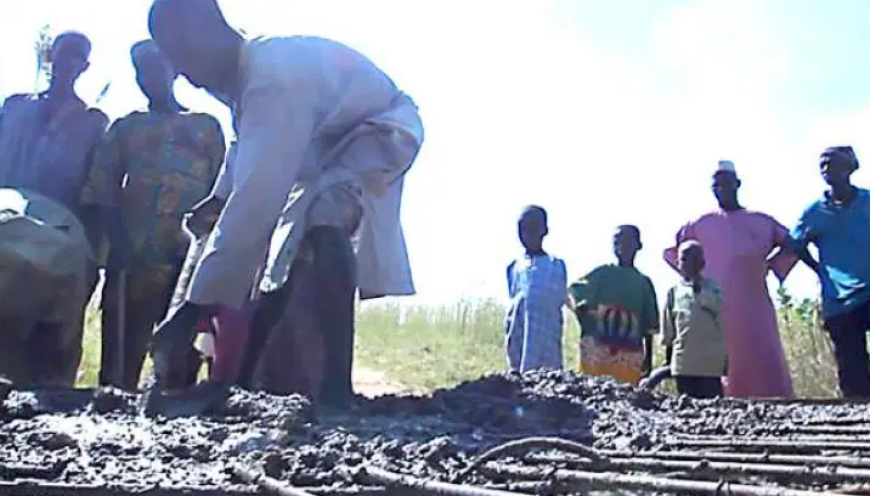
GUDUREGA, Sokoto State: In a quiet farming settlement tucked away in Fakka political ward of Sokoto State, hope is rising from the red earth moulded by hand, carried on weary shoulders, and cemented with determination. For more than half a century, the Gudurega community in Yabo Local Government Area waited for what many Nigerians consider basic: a functional secondary school.
Grabbing the bull by the horns
Today, tired of waiting, residents have taken their destiny into their own hands, literally building classrooms without a motorable access road, without electricity, and without certainty of when formal government intervention will come. The village, located about 20 kilometres southwest of Yabo town, survives largely on subsistence farming. A handful of residents cultivate sugarcane and mangoes, but most families depend on seasonal harvests to sustain their households. Yet despite limited means, they have mobilised resources and labour for what they call their most urgent investment: the education of their daughters.
We could no longer sit and watch our girls’ dreams fade,” said community elder Malam Sani Abdu Gudurega, standing beside a half-completed classroom block. “For over 50 years, we waited. Now we are building it ourselves even if we must carry every block on our heads.” And they do. With no access road to the site, men, women and youth trek daily along narrow footpaths, balancing cement, sand and water on their heads. During the rainy season, the path becomes nearly impassable, yet work continues. For Gudurega’s able bodied youth population, the project is more than construction, it is resistance against generational stagnation.
Difficulty for the girl-child
The village has an aging but functional primary school that has, for decades, graduated pupils who must travel to neighbouring towns such as Sanyinna or Yabo for secondary education. For boys, the distance is difficult; for girls, it has often been impossible. Many simply stopped at Primary Six. “My first daughter could not continue,” said farmer Shehu Muhammad. “We could not send her far away. But this new school will change that story for my younger children.”
Women to the rescue
Women in the community have emerged as some of the strongest advocates. Hajiya Salamatu Usman, leader of the women’s association, said the effort reflects a collective awakening. “When you educate a girl, you educate a nation. We are not just building classrooms; we are building confi- dence for our daughters.”
Gudurega mirrors a wider challenge
Gudurega’s story mirrors a wider rural education challenge across northern Nigeria, where distance, poverty and infrastructure gaps continue to limit girls’ access to secondary school education. Nationally, stakeholders have repeatedly stressed the importance of bridging the rural-urban education divide as part of broader development goals. Relief for Gudurega may be on the horizon. The Sokoto AGILE Project – Adolescent Girls Initiative for Learning and Empowerment has identified the village as a benefiting community. The initiative seeks to expand access to quality secondary education for girls, particularly in underserved areas.
During a recent inspection visit, the State Project Coordinator, Dr. Mansur Isah Buhari, praised the community’s resolve. “Our mandate is to expand opportunities for adolescent girls,” he said.
Inspiration by ownership
“When a community demonstrates this level of ownership, it strengthens the case for sustained government and partner support.” Residents say the intervention has renewed their morale. Still, they emphasise that the initial push came from within.
“Both state and local authorities know our situation,” but nothing was done over the decades, Malam Sani Abdu noted. “We have a polling unit here. We vote during elections. Yet for years, nothing changed. We decided to act.” Gudurega is not without social infrastructure. The village boasts a Jumu’at Mosque, about ten daily prayer mosques, and a functional borehole that complements locally dug wells. What it lacks are electricity, road access and until now a secondary school.
Gathering near hope
Children already gather near the construction site, watching walls rise against the dusty skyline. Twelve-year-old Zainab Almustafa, fresh out of primary school, says she dreams of becoming a nurse. “I want to continue my education here in my village,” she said quietly. “I don’t want to stop learning.” In a local government area with a population of over 115,000 people, Gudurega’s struggle underscores a national truth: access to education remains uneven, and rural communities often bear the heaviest burden.
Yet it also highlights something powerful: citizenship in action. For a village that waited five decades, hope is no longer a distant promise spoken at political rallies. It is visible in rising walls, in blistered hands, and in the determined eyes of girls who now see a future within reach. Across Nigeria, Gudurega’s message resonates clearly: education is not a favour to be granted, it is a right worth building, brick by brick.
Culled from vanguard