Blackouts dim Nigeria’s ‘Detty December’ glow
 admin
admin
Nigeria’s usually vibrant ‘Detty December’ festive season, typically characterised by lavish parties and homecoming celebrations, has been disrupted by widespread power outages as the country grapples with one of its worst electricity supply crunches in 2025.
BusinessDay’s findings showed the nationwide drop in electricity supply, triggered by an explosion at the Escravos-Lagos Gas Pipeline in Delta State, has throttled the country’s power output just as demand peaked for the ‘Detty December’ festivities.
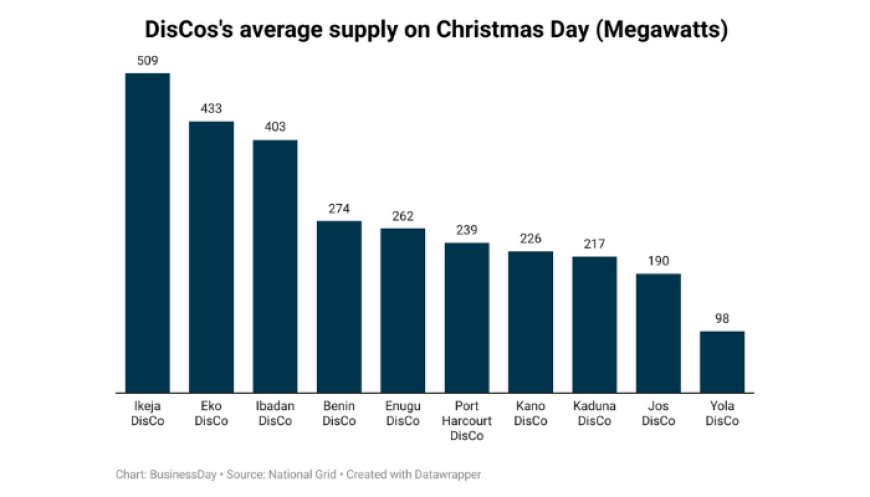
Further findings showed the eleven electricity distribution companies (DisCos) received a combined total of only 3,366 megawatts on Friday, a fraction of the generation needed to power a nation of over 250 million people.
Data from the Nigeria National Grid showed that Abuja and Ikeja DisCos received the highest allocations at 515MW and 509MW, respectively, followed by Eko (433MW) and Ibadan (403MW), underscoring how even the country’s commercial hubs were operating under constrained supply.
Benin DisCos recorded 274 MW, Enugu (262 MW), Port Harcourt (239 MW), Kano (226 MW) and Kaduna (217MW).
Other regions fared worse, with Jos (190MW) and Yola (98MW) among the lowest recipients, highlighting the uneven and insufficient distribution of the total 3,366MW shared across the 11 DisCos during the festive period.
For the Nigerian consumer, the timing could not be more punishing. The blackout arrives at a moment of peak seasonal demand and follows a year of punishing macroeconomic reforms.
“For many families, this is the one time of the year when everyone comes together, and electricity matters more than ever,” said Ngozi Uzordike, a resident of Lagos’ Surulere district. “We planned decorations and family dinners, but without light, everything changes. You either spend a lot on fuel or cancel your plans.”
Restaurants, bars and event centres, central to Nigeria’s festive culture, have faced higher operating costs as they run generators for longer hours. Some have passed those costs on to customers, while others have scaled back operations.
At a popular shopping district in Ikeja, Lagos, shop owners said foot traffic dropped sharply after dusk as the area remained without grid power for several evenings.
“People don’t want to shop in the dark or pay higher prices,” said Kunle Adeyemi, who runs an electronics store. “This season should be our best, but power is killing the mood.”
In the upscale districts of Victoria Island and Lekki, premium hotels and short-let apartments, which can command upwards of N300,000 per night during the holidays, are seeing their margins eroded by the soaring cost of diesel.
Smaller vendors are even harder hit. For artisanal bakers and cold-drink retailers, the lack of grid power is not merely an inconvenience; it is a threat to their seasonal survival.
Without refrigeration, the perishables intended for Christmas and New Year feasts get spoilt, and the ‘ice block economy,’ where businesses buy frozen water to keep products cool, has seen prices surge as demand outstrips the supply of those with working freezers.
The blackout woes come at a time when President Bola Tinubu’s administration is trying to overhaul the economy, including reforms aimed at attracting investment into the power sector. The government has pledged to expand generation capacity, strengthen transmission infrastructure and encourage states and private players to develop independent power projects.
While some states have begun pursuing localised power solutions, progress has been uneven. Analysts say that without significant improvements in transmission and distribution, additional generation alone will not solve Nigeria’s electricity problems.
Adebayo Adelabu, minister of Power, has moved to calm the mounting public anger, describing the outage as ‘temporary’ and promising a restoration of supply within 48 hours as repairs on the Escravos pipeline near completion.
“Electricity supply will be rapidly restored following the recent decline caused by a temporary shortfall in power supply. The situation is expected to be resolved within the next 24 to 48 hours,” Adelabu said in a statement seen by BusinessDay.
He emphasised that the disruption is temporary and directly linked to acute gas supply constraints affecting several thermal power generation stations.
However, for many, these assurances ring hollow.
Civil society groups, including the Electricity Consumer Rights Network (ECRN), have already begun calling for leadership changes, labelling the Christmas Day blackout a ‘monumental failure’ that underscores the stagnation of the power sector 13 years after its privatisation.
According to Osita Obi, convener of ECRN, the minister should not only resign but also tender an unreserved apology to Nigerians for what he described as the denial of stable electricity at a time traditionally associated with celebration, family gatherings and increased economic activity.
“In a civilised clime, he should not wait to be asked before throwing in the towel. There is no clear vision or capacity to lead a strategic ministry like the power ministry. He is a square peg in a round hole.”
Obi urged the federal government to move beyond what he termed ‘ritual excuses’ and take decisive action to reform the power sector, stressing that electricity remains central to economic growth, industrial productivity and the overall quality of life of citizens.
He also called for greater accountability from the Ministry of Power and its relevant agencies, insisting that Nigerians deserve transparent and timely explanations whenever nationwide outages occur, especially during critical periods such as major public holidays.
While the mass market recedes into the darkness, a ‘premium’ festive economy continues to thrive, fueled by dollar-denominated diaspora remittances.
These visitors, returning from London, Houston, and Toronto, are largely insulated from the blackout by high-end establishments that operate entirely off-grid.
Culled from Business Day