Digital shift threatens newspapers, newsroom jobs – NIJ provost
 admin
admin
The Provost of the Nigerian Institute of Journalism, Gbenga Adefaye, has warned that Nigeria’s newspaper industry is in rapid decline, with printed newspapers disappearing from the streets and traditional newsroom jobs that once sustained generations of journalists steadily vanishing.
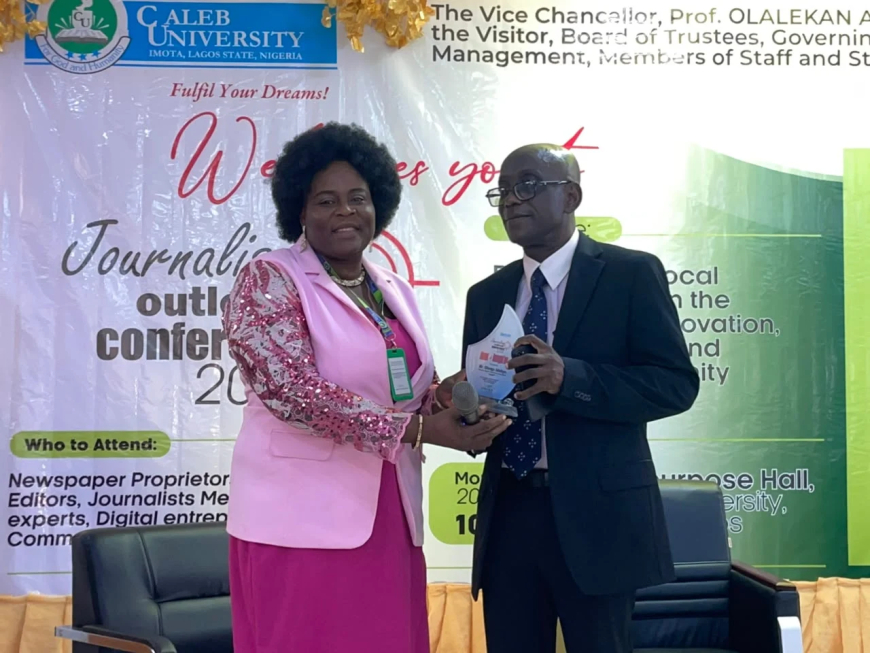
Adefaye spoke on Monday at the Journalism Outlook Conference 2026 held at Caleb University, Imota, Ikorodu, Lagos State, in partnership with the Nigerian Institute of Journalism and the Nigerian Guild of Editors.
The event was also attended by veteran journalist and publisher of community tabloid Oriwu Sun, Monzor Olowosago, students and other professionals from the university community.
In what marks a stark unveiling of the industry’s biting realities, the veteran editor said the decline of print journalism was now visible to anyone observing Nigeria’s cities.
Adefaye said the industry’s future now depends on how quickly publishers, journalism schools and practitioners reinvent themselves for a digital economy that has fundamentally altered how news is produced, distributed and consumed.
“A drive round any Nigerian city today tells its own story. The printed newspaper has become something of a memento, carried by a few remaining old vendors who, like the papers they hawk, are a dying tribe,” Adefaye said.
His remarks came as newspaper proprietors, editors, journalism educators and media executives gathered to examine the future of local newspapers at the conference themed, “Reinventing Local Newspapers in the Digital Age: Innovation, Sustainability and Global Community Impact.”
Unlike many discussions that frame digital transformation as an opportunity, Adefaye argued that the industry had already undergone irreversible structural change, with journalism schools still preparing graduates for careers that increasingly no longer exist.
“The formal, salaried newsroom jobs that once absorbed generations of graduates may simply no longer be there in the numbers they once were,” he said.
He explained that the traditional newsroom model, where reporters, photographers, sub-editors and production teams operated in clearly defined roles, had largely given way to a fragmented media marketplace driven by freelancers, contract workers and digital content creators capable of performing multiple functions.
According to him, journalism institutions must urgently redesign their curricula to reflect those realities by treating multimedia storytelling, digital journalism, social media management, strategic communication and media entrepreneurship as core competencies rather than optional additions.
Adefaye also warned that professionally trained journalists now compete directly with a rapidly expanding class of digital publishers operating with little overhead and few institutional barriers.
“There are now legions of publishers whose only factory is a laptop and a data subscription,” he said.
“Some, indeed, make open mockery of the trained journalist.”
He said the disruption had rendered obsolete the long-held assumption that journalism graduates would naturally transition into conventional newsroom careers after graduation.
The former Vanguard editor noted that the National Universities Commission had already recognised the changing media landscape by replacing the broad Mass Communication degree with specialised programmes including Journalism and Media Studies, Broadcasting, Public Relations, Strategic Communication and Development Communication Studies.
He said journalism schools must also invest in digital newsrooms, multimedia laboratories, podcast studios and production facilities that mirror the realities graduates will encounter after leaving university.
Rather than training students for the industry many senior practitioners entered decades ago, he said institutions should prepare them for a profession increasingly shaped by artificial intelligence, audience analytics, platform journalism and entrepreneurial content creation.
“The local newspaper, and the profession that built it, will only reinvent itself successfully if the people we train today are equipped for the world as it now is, not the world, however fondly remembered, that most of us came up in.”
Earlier, the Vice-Chancellor of Caleb University, Prof Olalekan Asikhia, argued that newspapers should stop thinking of themselves as businesses built around paper and instead become digital information enterprises centred on public trust.
“The digital revolution did not kill newspapers. It killed obsolete business models.
The real product has never been paper. The real product is credible information,” Asikhia said.
He proposed seven priorities for rebuilding local journalism, including digital-first publishing, artificial intelligence, hyperlocal reporting, audience engagement, diversified revenue, trust-building and partnerships with technology firms, universities and civil society organisations.
Also speaking, the General Secretary of the Nigerian Guild of Editors, Mr Onuoha Ukeh, who represented the Guild President, Mr Eze Anaba, said local newspapers would only remain relevant by embracing innovation while developing sustainable business models beyond traditional advertising revenue.
He urged publishers to invest in digital subscriptions, memberships, events, grants, investigative reporting and audience-centred journalism capable of rebuilding public trust.
The conference concluded with a broad consensus that while local newspapers still occupy an important democratic role, their survival will depend less on preserving legacy print models than on successfully adapting to an increasingly digital and competitive media environment.
Chief Olowosago also delivered a rounded intervention which tasked media practitioners with various means and strategies to stay afloat in the industry.
Norwegian media expert Marie Myklebust, billed for the event, could not attend because of health-related issues, The PUNCH gathered.
President of the NGE, Anaba, was represented by the Vice President South West, Kabir Garba.
A panel discussion featuring media development expert Lekan Otunfodurin centred on the challenges confronting local newspapers amid rapid digital transformation, with participants exploring innovative business models, technological adaptation, sustainability strategies and ways of strengthening the global impact of community journalism.